 |
|
Italian Maiolica: Ceramics of the Renaissance
|
|
The evolution of the
term Maiolica is almost as interesting as the development and spread
of the style itself.
There are four different meanings associated
with the term.
-
In origin the word is a
medieval Italian form of the name of the island of Majorca.
-
Renaissance Italians
used the term to describe Hispano-Moresque imports and other
luster wares, which were sometimes shipped through Majorca to
Italy.
-
In modern Italian (and
some parts of Italy in the 16th century) its meaning
has broadened to ‘tin glazed earthenware’.
-
In English, it is used
to refer to tin glazed earthenware in the stylistic tradition of
the Italian Renaissance.
Note: ‘Maiolica’
may be spelt ‘Majolica’. Both terms are used in modern references
and considered equally valid and inter-changeable.
The principal colors of
Maiolica are: blue
(cobalt), green (copper), purple and brown (manganese), yellow
(antimony), orange (antimony and iron) and white (tin).
|
|
Ceramic Origins
|
|
Tin glazed items were not invented by the Italians, in fact the
beauty of eastern ceramics had been well known to the Renaissance
Italians for a long time.
The first examples of this technique were
found in Baghdad and dated to the 9th Century - there
symmetrical patterns were painted in blue and white.
However by the by the end of the 11th century Islamic
pottery, including lusterware, had been in widespread use for the
embellishment of religious and civic buildings. Thought to have been
introduced by the crusaders at the as trophies demonstrating
victories over the pagans by powerful Christian forces.
During the 13th
through to the early 15th century Tuscany had good trade
relations with Moorish Spain and imported large quantities of
lusterware from Spain. This is when the Italians began to work with
tin glazed ware. It is interesting to note that the only difference
between the Italian and Spanish products of this period is the
absence of luster on the Italian wares.
The map below shows
the sweeping migration of tin glazed tradition from Baghdad, then
with the advance of Islam, it was carries the length of the Northern
African seaboard into Moorish Spain, this occurred during the 10th
Century. Then during the 13th Century through to the 15th
Century, Spanish pottery was transported through Majorca to Italy.

The Italians took
great pains to copy the styles of the Spanish and Islamic designs
but remained ignorant to the production of luster tones which were
found on these tin glazed ceramics. In place of the luster, the
Italians imitated the effect by using orange-yellow color through
fine manganese.
Italian Maiolica
eventually dominated the pottery of Europe and set a trend that
lasted more than three hundred years.
The
most common surviving pieces from the earliest period of majolica
are storage vessels made for monastic pharmacies, usually labeled
to indicate their contents and decorated with contemporary
Hispano-Moresque motifs or the symbols of saints credited with
healing powers. Because of Islamic prohibitions against it, the
human form was rarely depicted on majolica pottery prior to 1450
but became characteristic of its design by the beginning of the
16th century. The majolica of Deruta is noted for its stylized
portrait heads and figures and seems to have been the first
Italian ware to adopt (c.1500) the Valencian technique of of using
luster glazes to produce metallic and iridescent effects. From
Deruta the technique was probably brought to Gubbio, where a
ruby-red luster color was evolved. Relief-molded wares, designed
to enhance the brilliance of the iridescence, were produced at
both towns.
In
the late 15th century majolica became more decorative and less
functional. Dishes and vases were designed primarily for display,
especially the pictorial narrative styles associated with Urbino.
Subjects for illustration were taken from Roman history, Greek and
Roman mythology, the Bible, and occasionally from contemporary
literature. Imagery was often derived from engravings or from
woodcut book illustrations.
Sixteenth-century
majolica decoration evolved away from pictorialism and was
frequently derived from engravings of ornamental motifs, published
for the use of decorative designers. These motifs, following the
prevalent enthusiasm for Greek and Roman antiquities, conjured up
a pagan world populated by cupids, satyrs, sphinxes, and other
mythical beings. Acanthus foliage, palmettes, and the Roman
"trophy" of arms were common motifs. From the East, by
way of Venice and Islamic metalworkers there, came the arabesque
style, a continuous interlacing of formalized leaves and branches.
At Urbino a sophisticated style evolved that consisted of a
bizarre medley of winged monsters, grotesque semi human creatures,
urns, and masks, linked by swags and garlands. These delicately
painted, whimsical grotesque elements were set off by a
technically perfect white glaze. The Urbino factories also
produced small statues, whose forms were inspired by contemporary
work in bronze. The ultimate reaction against the overworked
polychrome narrative style was the plain white ware of Faenza, the
thick glaze appreciated for its own sake. The dispersal of
majolica craftsmen, particularly from Faenza, exerted a profound
influence on European pottery styles and, in particular, of the
Netherlands, where, in the early 17th century, the tin-glaze
technique was taken up and used to imitate Chinese porcelain.
Betty
Elzea Bibliography: Pica, Agnoldomenico, Italian Majolica Tile,
trans. by James Pallas (1971); Rackham, Bernard, Italian Maiolica
(1952); Schneider, Mike, Majolica (1989).
|
|
About Pottery
The production of pottery is one of the most ancient arts. The
oldest known body of pottery dates from the Jomon period (from about
10,500 to 400 BC) in Japan; and even the earliest Jomon ceramics
exhibit a unique sophistication of technique and design. Excavations
in the Near East have revealed that primitive fired-clay vessels
were made there more than 8,000 years ago. Potters were working in
Iran by about 5500 BC, and earthenware was probably being produced
even earlier on the Iranian high plateau. Chinese potters had
developed characteristic techniques by about 5000 BC. In the New
World many pre-Columbian American cultures developed highly artistic
pottery traditions.
|
|
Types of Wares
Pottery comprises three distinctive types of wares. The first type,
earthenware, has been made following virtually the same techniques
since ancient times. Earthenware is basically composed of
clay--often blended clays- -and baked hard, the degree of hardness
depending on the intensity of the heat. After the invention of
glazing, earthen-wares were coated with glaze to render them
waterproof; sometimes glaze was applied decoratively. It was found
that, when fired at great heat, the clay body became nonporous. This
second type of pottery, called stoneware, came to be preferred for
domestic use.
The
third type of pottery is a Chinese invention that appeared when
feldspathic material in a fusible state was incorporated in a
stoneware composition. The ancient Chinese called decayed feldspar
kaolin substance known in the West as china clay.
Two
types of porcelain evolved: "true" porcelain, consisting
of a kaolin hard-paste body, extremely glassy and smooth, produced
by high temperature firing, and soft porcelain, invariably
translucent and lead glazed, produced from a composition of ground
glass and other ingredients including white clay and fired at a low
temperature.
|
|
Decorating Techniques
In the course of their long history potters have used many
decorating techniques. Among the earliest, impressing and incising
of wares are still favored. Ancient potters in Egypt, Mesopotamia,
Greece, northern India, and the high regions of Central Asia
frequently decorated wares with impressed or incised designs.
An
especially popular type of decoration involved the sgraffito, or
"scratched," technique used by Italian potters before the
15th century.
By
the 16th century Italian potters working mainly in Padua and Bologna
had developed great skill in sgraffito, which entailed the incising
of designs on red or buff earthenware that had been coated with
ordinary transparent lead glaze, usually toned yellow or, sometimes,
brown, copper, or green.
Just like today, after firing, the wares were dipped into white clay
slip so that a dark pattern could be cut on the surface. By cutting
through the white slip, the artist produced a design on the exposed
red or buff body. Pigments were also sometimes applied. After a
further coating of lead glaze the ware was fired a second time.
A
sound knowledge of glazes--both utilitarian and decorative-- is
vital to the potter. The origin of glazes and glazing techniques is
unknown, but the fine lustrous glazes developed in China surely
began with a simple glaze that served to cover earthenware and
render it watertight.
Potters in Mesopotamia and Iran commonly used an alkaline glaze made
of quartz mixed with sodium and potassium. An admixture of colored
metallic oxides, mostly lead, was introduced later.
Painting
on pottery and porcelain became richly colorful in many regions and
periods.
For
a long period ceramic artists had used only black or brown pigment
to decorate wares that were then covered with clear glaze. It is
believed that the appearance in China of 13th-century
brush-decorated wares from Persia sparked a change. These works,
painted in blue cobalt under the glaze, inspired the brushwork of
the Chinese, and the resulting so-called blue-and-white style
prevailed for a long time.
In
the Islamic world, ceramic decorative art flowered with the creation
of a great diversity of painted wares. Painted luster decoration on
pottery originated in Mesopotamia and spread to ancient Egypt;
later, under Islam in Persia, this type of decoration on
white-glazed wares became incredibly brilliant. Islamic
luster-painted wares were later masterfully developed by Italian
potters during the Renaissance.
|
|
EARTHENWARE
A distinctive type of earthenware known as majolica, appeared in
Italy during the last quarter of the 14th century. It is now
believed that this type of painted earthenware was inspired by the
Hispano- Moresque luster-decorated ware of Spanish origin introduced
to Italy by Majorcan seagoing traders.
Majolica
ware, whether thrown on the wheel or pressed into molds, was fired
once to obtain a brown or buff body, then dipped in glaze composed
of lead and tin oxide with a silicate of potash. The opaque glaze
presented a surface that was suitable to receive decoration. A
second firing after decoration fixed the white glaze to the body and
the pigments to the glaze, so that the colors became permanently
preserved. Frequently, the beauty of these wares was increased by
dipping them in a translucent lead glaze composed of oxide of lead
mixed with sand, potash, and salt. When certain luster pigments and
enamels were used in all-over painting, wares had to be specially
fired at low temperature. Application of metallic luster pigments
required great skill because these colors were extremely volatile
and needed special handling.
Luca
della Robbia work raised majolica production from a craft to high
art in Italy. Not only did he use blue and white enamels in
decorative work, but, as a sculptor, he also used the majolica
technique to add brilliance to the surface of his productions…
|
|
ABOUT
ARABESQUE’
{air-uh-besk'}
In art, an arabesque is a decorative pattern composed of rhythmic,
curvilinear designs. The term, derived from the Italian Arabesco
("Arab-like"), is usually associated with the intricate
geometric or foliated scrollwork seen in Islamic architecture,
miniature painting, and minor arts.
The
motif was also employed in the late Roman and Renaissance periods.
|
|
ABOUT
“GROTESQUE”
{groh-tesk'}
The term grotesque, an English borrowing from the Italian grottesca,
was first applied by Renaissance archaeologists to classical Roman
fresco paintings discovered in excavations then called grotte, or
caves. The extravagant combinations of animal, plant, and human
forms found in such paintings were quickly imitated by artists and
followers of Raphael. Since the 18th century the term has gained a
wide and imprecise literary currency, and refers to fanciful or
distorted images of natural forms used for comic or alarming effect.
|
|
THE
RENAISSANCE
The term Renaissance, adopted from the French equivalent of the
Italian word rinascita, meaning literally "rebirth,"
describes the radical and comprehensive changes that took place in
European culture during the 15th and 16th centuries, bringing about
the demise of the Middle Ages and embodying for the first time the
values of the modern world.
|
|
THE
RENAISSANCE IN ITALY
The "rebirth" of art in Italy was connected with the
rediscovery of ancient philosophy, literature, and science and the
evolution of empirical methods of study in these fields.
Central to the development of Renaissance art was the emergence of
the artist as a creator, sought after and respected for his
erudition and imagination.
|
|
The Early
Renaissance
The principal members of the first generation of Renaissance
artists--Donatello in sculpture, Filippo Brunelleschi in
architecture, and Masaccio in painting--shared many important
characteristics. Central to their thinking was a faith in the
theoretical foundations of art and the conviction that development
and progress were not only possible but essential to the life and
significance of the arts.
The
Early Renaissance was not, as was once maintained, merely an
imperfect but necessary preparation for the perfection of High
Renaissance art but a period of great intrinsic merit.
The
High Renaissance
The High Renaissance style endured for only a brief period
(c.1495-1520) and was created by a few artists of genius, among them
Leonardo da Vinci, Donato Bramante, Michelangelo, Raphael, and
Titian.
The Late
Renaissance
A major watershed in the development of Italian Renaissance art was
the sack of Rome in 1527, which temporarily ended the city's role as
a source of patronage and compelled artists to travel to other
centers in Italy, France, and Spain. Even before the death of
Raphael, in 1520, anticlassical tendencies had begun to manifest
themselves in Roman art.
Patronized
by leading banking families like the Medici, the classicizing Early
Renaissance style was initiated in Florence during the 1420s by
Filippo Brunelleschi, Donatello, and Masaccio. Through his study of
Giotto, Masaccio had rediscovered the Italian classical tradition,
and, traveling together to Rome, Brunelleschi and Donatello derived
new understanding of antiquity by studying ancient Roman ruins and
sculptures. Their observations, coupled with the humanistic Tuscan
intellectual climate, engendered an avant-garde aesthetic that
replaced the Gothic in Italy by the end of the century.
Florentine
architects determined the design standards for Early Renaissance
buildings. Churches were organized on either a central plan or a
combination central and rectangular plan. Residential palaces were
developed around a central arcaded courtyard, or cortile. The
relationship of architectural proportion and human scale was a
Renaissance concern first manifested in the works of Brunelleschi.
Donatello
was the most influential Early Renaissance sculptor. His David
(c.1430-32; Bargello, Florence), the first free-standing bronze nude
statue since antiquity, revived the classical compositional device
of contrapposto, showed a concern for psychological interpretation,
and displayed a scientific, as well as an erotic, interest in the
human body. Poetic mood and lyrical line or contour typified the
busts and reliefs of mid-century Florentines such as Luca della
Robbia and Desiderio da Settignano. The anecdotal realism of
Verrocchio, Andrea del and the energetic studies of the figure in
motion of Antonio Pollaiuolo were dominant in late-15th-century
Florence.

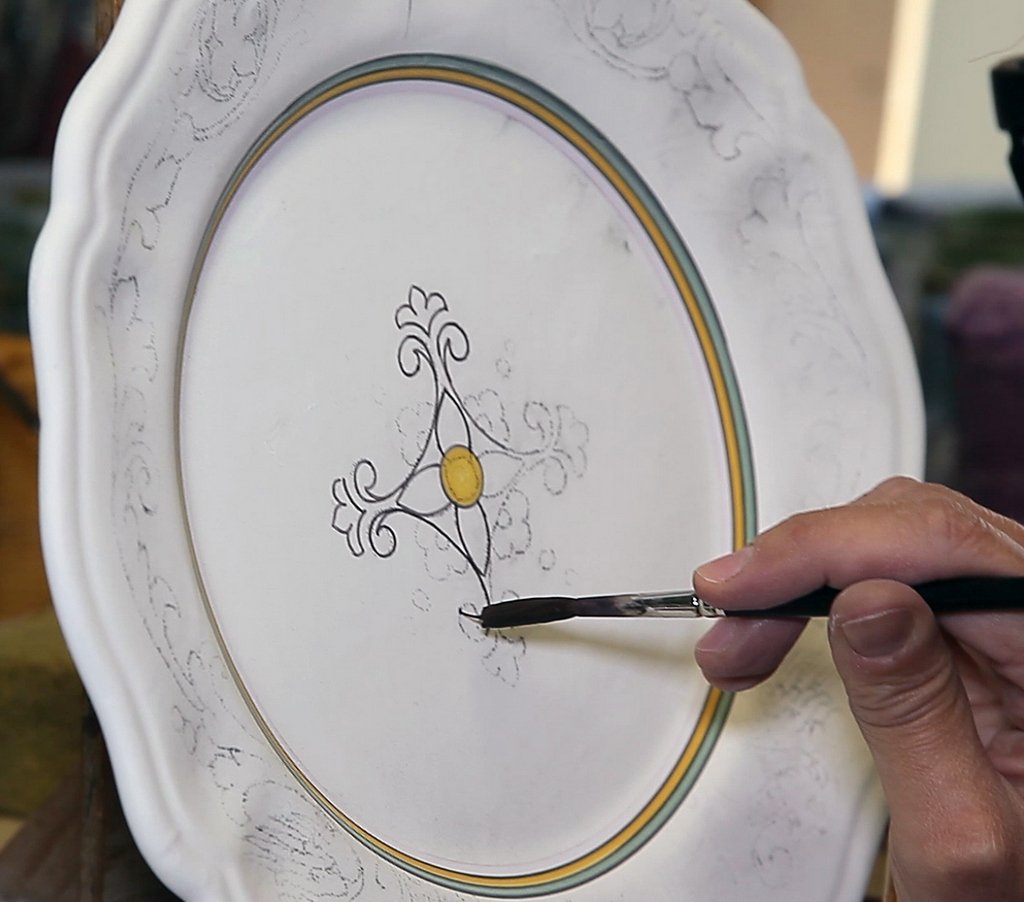
Learn about the Making of
Italian Majolica
|
|
References:
Dawe N, 1993, La Maiolica, Pottery in Australia, Spring, Vol 32 No 3,
pp 30 – 31.
Morley-Fletcher H, 1984, Techniques of the World’s Great Masters of
Pottery and Ceramics, Chartwell Books New Jersey.
Spronk P, 1984, The Delft Blue Wall Tile: A short story from Holland,
Pottery in Australia, May/June, Vol 23 No 1, pp14 – 19.
Wechler S, 1981, Low Fire Ceramics – A new direction in American clays,
Watson-Guptill Publications NY.
Wilson T, 1989, Maiolica: Italian Renaissance Ceramics in the Ashmolean
Museum, Oxford University London. |
 |
|
|